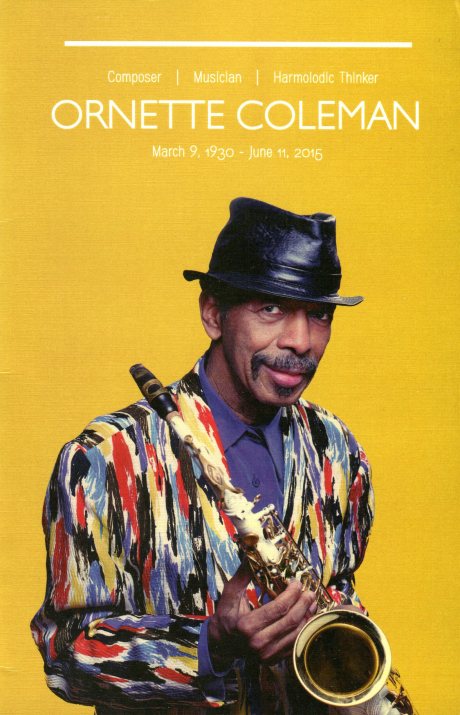
Jazz great Ornette Coleman, known for his Harmolodic approach to music and expansion of the field of jazz, died on June 11, 2015. He’s been the subject of an exhaustive list of obituaries assessing his work and New York FM radio station WKCR—known for its memorial broadcasts for jazz musicians–turned over its airwaves to play nothing but Coleman’s music for a full week after his death.
He’ll likely be the subject of many tributes to come, but the one people were looking forward to was held on June 27, in Manhattan’s historic Riverside Church, which was filled with hundreds of people from the jazz world and fans who wanted to share one last moment of reflection on Coleman’s life.
Recurring themes were Coleman’s gentle spirit, ferociously creative artistic drive, and overall humanity, which were the starting points for most of the musical and spoken tributes.
The event was emceed by veteran educator, jazz historian, and WKCR radio broadcaster Phil Schaap, who opened the proceedings with his recollections of Coleman. Schaap related Coleman’s history with the radio station — which was a long one– and culminated with their weeklong tribute to Coleman which played only his music continuously for the week after his death. In addition to their memorial broadcasts, WKCR is also known for their birthday broadcasts where they focus on the work of a single artist for 24 hours. Coleman had additional significance in that he was the last living musician to be honored in that way.
Howard Mandel: “Ornette didn’t play free jazz; he freed jazz.”
Author and Jazz Journalists Association president Howard Mandel offered his own reflections on Coleman, recalling interviews with him and concluding that “Ornette didn’t play free jazz; he freed jazz.”
Award-winning Amsterdam News journalist Herb Boyd was tasked by Coleman’s son Denardo to assume the monumental job of assessing Coleman’s contributions to Black culture. Boyd focused on Coleman’s forward thinking aesthetics, pointing out that some artists “not only capture the essence of black culture — the past the present — some of them look into the future and the rest of the culture has to catch up”.
Pianist Cecil Taylor read 2 poems for Ornette and then played a tribute. Taylor’s become somewhat reclusive in recent years and it was a rare opportunity to see him perform and read his work.
Journalist Larry Blumenfeld recalled that Coleman “also liberated the world around jazz”, noting that “it’s harder to live harmolodically”: the latter a referral to Coleman’s signature musical style, which he took as a directive that went beyond music.
Blumenfeld said that “Ornette always talked about tones and sounds, but never notes” because he realized that individual notes could get trapped in spaces. In a nod to Coleman’s true commitment to harmolodics, Blumenfeld pointed out that “getting to know Ornette and his son [Denardo] taught me that you could parent harmolodically — without hierarchichies”. Blumenfeld posted his thoughts on Coleman after the service.
Poet, activist, broadcaster (and now Newark mayor Ras Baraka’s communications director) Felipe Luciano recalled that he and Coleman “never spoke about music. We spoke about God. We spoke about mysticism.” Luciano explained that his talks with Coleman had a calming influence on him as a young activist and also pushed him to think more deeply about his politics, the world, and how he related to people. Their discussions led to more complex questions: “How can we get beyond [the limitations of the world]? How can we fly?” Luciano ended with a poem dedicated to Coleman.
Ornette Coleman: “Everything is music”
Vibraphonist and pianist Karl Berger recalled that Coleman “wanted you to go beyond simple logic” “He always wants you to find your own intuitive logic, your own music.” Coleman told him that “thinking is too slow for music making”, instead stressing intuition: the ability to feel intuitively what’s happening and respond musically according to those feelings. Berger remembered Coleman once being asked what he was listening to and replying “everything”. “Everything”, the questioner asked, to which Coleman replied, “Everything is music”.
Visual artist Mel Edwards recalled that one connection they both had was in being Texas natives. “Like Texans of our generation, we went west to go north”, Edwards explained. Edwards and Coleman were both part of the Los Angeles Black Arts cultural scene before Coleman took up residence in New York.
Edwards stressed the mutual understanding they shared of the importance of being politically committed artists and the commitment to not simply creating “art for art’s sake”, but rather the imperative to create art that would help people see clarity in the world and somehow improve their lives.
Henry Threadgill and pianist Jason Moran collaborated on the composition “Sail”, written specifically for the tribute.
Yoko Ono recalled that she knew Ornette “for 50 short years” and choked back tears while cradling an unfinished scarf she knitted for him and left it on the podium as a reminder. While Ono had little to say, her inability to articulate more than she did spoke volumes about the deep connection she felt with Coleman and the level of loss she felt.
Coleman’s been laid to rest in Woodlawn Cemetery in The Bronx along with a host of other jazz greats. The tribute and his musical and personal legacy suggest that he is indeed in good company and that although he’s gone, his influence will live on for a long time.
Hank Williamsis an associate producer for Suga’ in My Bowl on WBAI Radio and webmaster for the Suga’ and Behind the Mic sites. He is also a PhD candidate in English and Africana Studies at the CUNY Graduate Center and teaches at Hunter and Lehman Colleges and The City College of New York.
Joyce Jonesis producer and host of Suga’ in My Bowl on WBAI Radio. A graphic artist by training, her photography has also been published in the Black Renaissance Noir journal
It’s no secret that we’re big fans of pianist Vijay Iyer‘s work at Suga’ in My Bowl radio. Since we did a partial profile on him back in 2010 (audio archived here), we’ve caught him several times, including leading his own trio with bassist Stephan Crump and drummer Marcus Gilmore, collaborating with the TRIO 3 ensemble of veterans Oliver Lake, Reggie Workman, and Andrew Cyrille, or in any number of one-off combinations and collaborations. In short, we think a lot of him and his work and in that regard we’re far from alone.
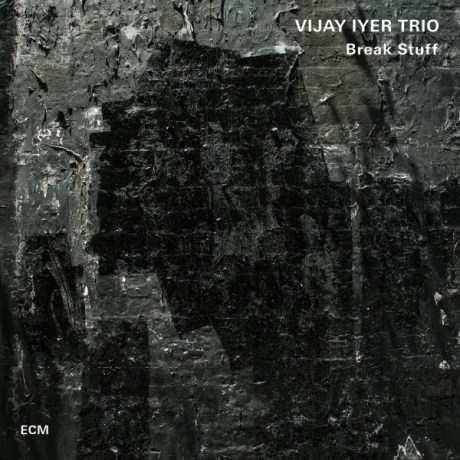
That’s one reason why we were excited to finally get our hands on the just-released Break Stuff, on which appears several songs that we’d heard in various stages of workshopping by Iyer and the trio. It shows the incredible range of interests and influences that Iyer channels into his work and if you’re an Iyer fan, you should probably just go get it.
But this post is actually about the “EPK” (Electronic Press Kit)– promotional video to most of us — for the release, which I can’t stop watching.
Granted, music videos are nothing new — indeed, MTV and MTV-2 built their reputation on them even if they don’t bother actually play them much anymore — and groups known primarily to the jazz world have even dabbled in the genre to varying levels of success.
The EPK, however, is a slightly different animal, combining features of a traditional music video with that of the “press kit” that would generally go out primarily to journalists with written background info on the artists, creative process, and the like that said journos could use to write up a story or review. But it’s the 21st Century! So, just like everything else, there’s a transition to video and some of the things you previously had to tell people, you can now show. And since you’re already spending money on the thing, then why not just throw it up online for everybody?
That’s what’s happening now and as a result, for a lot of releases you now get a preview of the entire album with artist commentary and background info. When done right, they’re nicely produced mini-documentaries and the one for the Vijay Iyer Trio’s Break Stuff is done right.
In the video, we get a seven-and-a-half minute walk through of the various songs that make up the release and insight to how things ended up being produced the way they are, such as Iyer’s decision to include the words from Nigerian-American writer Teju Cole‘s novel Open City and riffs on hip hop and break beats, name-checking Jeff Chang’s now classic narrative of hip hop history Can’t Stop Won’t Stop in the process. Crump and Gilmore are here, too and reveal a fair amount of their contributions to shaping the final release, including Gilmore’s near-obsessive attention to detail that confirms something I’ve seen him do: re-tune his drums in the middle of a live set. It’s fascinating stuff if you like to dive deep into the music.
To be sure, there are some issues to think about here, especially considering the cost of producing these things and availability of the platform: an artist with barely enough money to produce a full release that fits their vision as is will be hard pressed to also pay someone to professionally do a video and it also takes a certain amount of media savvy to pull all of this off. So there’s a possibility that promo videos like this will widen the existing gaps between artists.
But they’re a lot of fun to watch and you’ll get some behind the scenes action as well. So just watch it right now if you haven’t seen it yet. Even if you already have a copy of Break Stuff, you’ll probably get something from hearing Iyer, Crump, and Gilmore talk about it. If not, it might make you want to hear more, which, happily, you can.
We’re due to bring Iyer back for a full interview on the radio show and hope to make that happen soon. Of course, we’ll let you know when that happens.
Meanwhile, I have to settle down and give the album itself some undivided attention.
Have you given Break Stuff a good listen? What are your thoughts on it or the video? Let us know in the comments.
Hank Williamsis an associate producer for Suga’ in My Bowl on WBAI Radio and webmaster for the Suga’ and Behind the Mic sites. He is also a PhD candidate in English and Africana Studies at the CUNY Graduate Center and teaches at Hunter and Lehman Colleges and The City College of New York.
After the 2015 Winter Jazz Fest wrapped up Saturday night I was left with 2 thoughts: damn am I tired and I can’t wait until next year.
The WJF, now in its 11th year has settled into a groove of being a welcome outpost of music in an otherwise dark month. The shows are an insanely good deal for the amount of top-notch music to be had and it offers a jazz overload over the course of their two main “marathon” days on Saturday and Sunday nights: January 9th and 10th.
I covered some festival logistics in a First Look and a guide to a few highlights in a Cheat Sheet and more or less stuck to the plan. The cheat sheet has an outline of some key acts to look forward to – including some I knew I wouldn’t catch and aren’t reviewed here. The plan was to see a few key groups and minimize venue changes.
I suggested earlier that the WJF is a victim of its own success. It now has to balance support for clubs that feature jazz year-round with the need for larger venues for the more popular acts. Gaining the historic Judson Memorial Church–back this year and home of event registration—as a venue has helped immensely. It’s one of the larger spaces and an excellent event space. Indeed, Arts for Art’s annual Vision Festival moves to Judson this July as well.
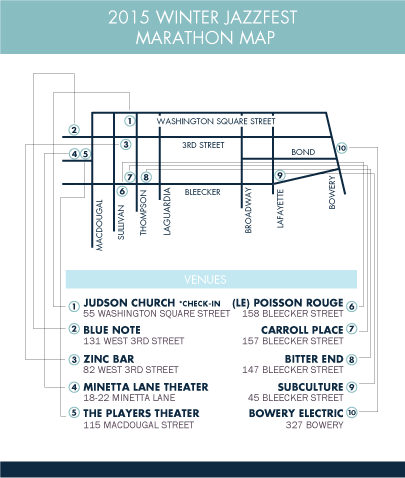
Gone was the Groove Lounge, which was almost comically small for saxophonist Gary Bartz’s set last year, and added to the mix were a few new spaces, including Subculture, the Players Theater, and the Minetta Lane Theater. Zinc Bar is still on the program and was still pretty much a no-go unless you got there before daily events started and stayed there. Minetta provided a much-needed larger space, in addition to Judson and Le Poisson Rouge, which returned as a cornerstone venue.
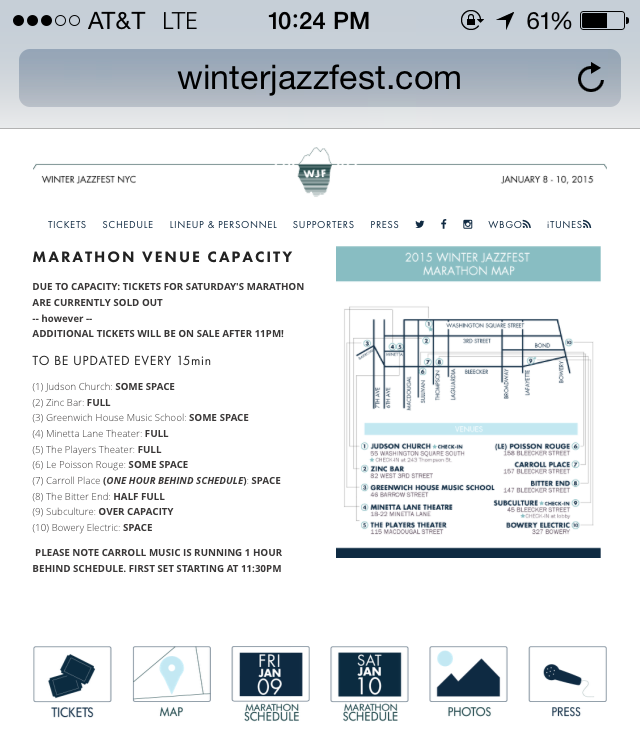
The WJF boosted the number of venues this year to 10 on both Friday and Saturday nights, which points to the event’s robust appeal. It wasn’t enough and tickets still sold out on Saturday. Festival organizers put the total headcount at 6,500 total over the 3 festival days (there were 2 standalone concerts on Thursday) with the bulk—5,500—split between Friday and Saturday nights. Also new this year was a very handy webapp that let you do a quick online check of crowds and space in a venue. Very cool! Unfortunately, it was sometimes the bearer of bad news and you often got the message you see below. Still, it’s a huge step forward and could be the deciding factor for someone trying to decide whether or not to leave and see an act in a different location.
Event registration/check-in still had its woes. Lines snaked down the block and around the corner to enter Judson’s basement where it was housed, but volunteers were cheerful and efficient once one got inside.
If there’s one lesson to be learned, that’s that you have to stay up (relatively) late to catch some of the good stuff.
If there’s one lesson to be learned, that’s that you have to stay up (relatively) late to catch some of the good stuff. That was my experience last year and I expected the same this year and was not disappointed.
Friday Highlights
I made the decision early on to focus on the acts at Minetta Lane: to get a close look at a few specific artists and catch all of David Murray’s shows, as our Suga’ in My Bowl radio show did a show on him. It’s one of the wonderful (and sometimes frustrating) decisions to be made: who do I see? Of course it is a dilemma because there are often overlapping shows that are appealing, which is the type of problem a lot of festivals would dream of having.
Saxophonist David Murray was all over the festival this year and anchored back-to-back sets at Minetta Lane, first with his Clarinet Summit and then what they dubbed the “Geri, David, and Terri” show with drummer Teri Lyne Carrington and pianist Geri Allen.
Murray’s Clarinet Summit featured Murray himself and Don Byron on sax and clarinet, veteran sax player Hamiet Bluiett on baritone, David Krakauer on clarinet, bassist Jaribu Shahid, and drummer Nasheet Waits. Waits and Shahid would also join Murray the next day as part of his Infinity Quartet.
Murray dedicated a new composition titled ” The Long March to Freedom” to the late Amiri Baraka
Murray dedicated a new composition titled ” The Long March to Freedom” to the late Amiri Baraka, who he described as “a great leader of our people”, noting the one year anniversary of Baraka’s death and that it’s also the title of Nelson Mandela’s book, which Murray said he “read 3 times until it fell apart”.
Baraka’s absence will still be felt in a lot of spaces on the avant-garde New York jazz scene this year. Murray and Baraka collaborated on the New Music-New Poetry (1982, India) release as well as Baraka’s play Primitive World. More to the point, Baraka, in addition to being a writer and critic of the music, could often be seen at performances even if he wasn’t scheduled to read himself, hanging out in the background and digging the music.
The Clarinet Summit also performed a song composed by the late Butch Morris (another figure whose absence is notable), punctuated by Krakauer hitting–and holding–an impossibility high note for an incredibly long time. Nasheet Waits ably held down the rhythm section with a smoking performance on the drums.
Murray’s second set of the evening was a trio with Allen and Carrington. Allen and Carrington have collaborated a fair amount and some of the most satisfying parts of the set came from their interplay, which often developed into long improvisational grooves with Allen starting a theme and Carrington responding on the drums or vice-versa. Allen’s delicate touch on the piano perfectly complemented Carrington’s drumming.
Displaying the confidence that comes from experience, Murray was content to watch the magic unfold as he listened, waiting for the right space to add his voice to the mixture.
Murray displayed another side of his personality and ability as a leader. Displaying the confidence that comes from experience, Murray was content to watch the magic unfold as he listened, waiting for the right space to add his voice to the mixture.
This slideshow requires JavaScript.
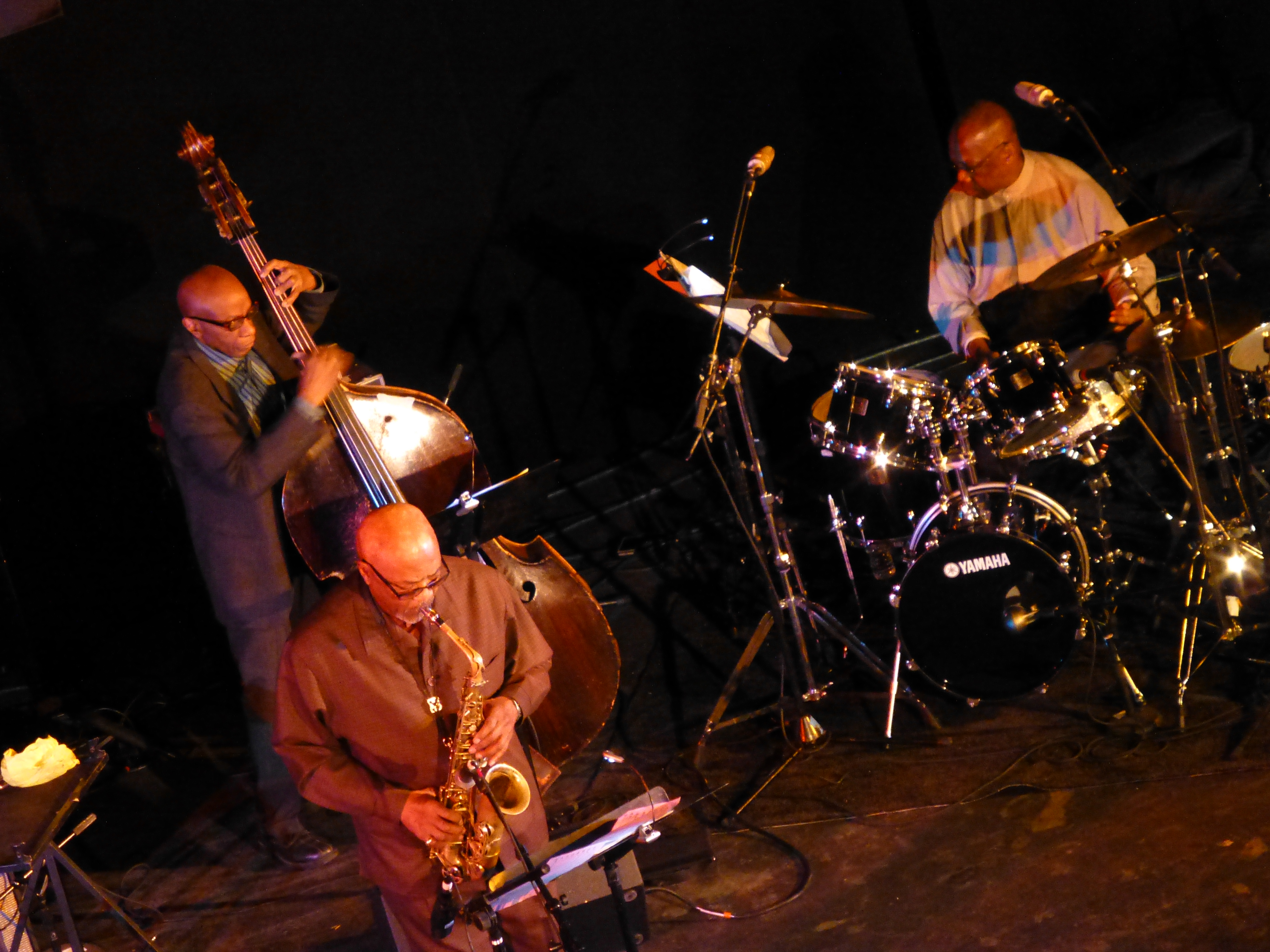
Saxophonist Oliver Lake, drummer Andrew Cyrille, and bassist Reggie Workman have been performing together as TRIO 3 for 2 decades now. The amazing thing is that they manage to return to the format with the numerous other projects that they all have going on. Nevertheless, they do and that’s a good thing.
This slideshow requires JavaScript.
Vijay Iyer joined the veteran trio on piano for the set, reprising his guest role on their 2014 Wiring release. Iyer was in the odd spot of being the junior member of an ensemble. It’s a role he easily slipped into, however, adding color with his staccato and slightly angular style, which complemented the work of the main trio well. It was also an interesting counterpoint to Geri Allen–who has also held the TRIO 3 guest spot—but has a much different style on the piano.
Friday evening’s highlight of was arguably guitarist Marc Ribot and the Young Philadelphians with strings. Ribot’s a familiar face on the NYC jazz scene and on the WJF stage: indeed, his collaboration with guitarist Mary Halvorson a memorable moment at last year’s festival. The Young Philadelphians ensemble also played the WJF in 2012 with a slightly different line-up: a performance that can be seen on YouTube.
This time they were back in a set in a main venue to cap off the evening. The 400-seat Minetta Lane Theater, which had largely emptied after the David Murray and TRIO 3 sets, had again filled and was taken on a quick tour of 1970s soul, funk, and even—gasp—disco by the blistering set.
Ribot, bassist Jamaladeen Tacuma, and drummer G. Calvin Weston, and frequent Ribot co-conspirator guitarist Mary Halvorson were joined by a string section of Christina Courtin on viola, Christopher Hoffman on cello, and Dana Lyn on violin.
This slideshow requires JavaScript.
While they don’t have any official releases, they’ve been touring and performing for a few years now in slightly different lineups. The group describes itself as melding “[t]he mind-blowing harmolodic punk-funk of Ornette Coleman’s first Prime Time band and the sweet, optimistic pulse of 1970s Philly Soul”. The task is helped along by PrimeTime alumni Tacuma and Weston, both steeped in the groundbreaking saxophonist’s harmolodic tradition – one Ribot is a serious fan of himself, as witnessed by his recent City Winery show with fellow Harmolodic guitar disciple and Coleman alum, James Blood Ulmer.
The Young Philadelphians dug deep into the 1970s funk, soul, and disco crates with covers of People’s Choice’s “Do it Any Way You Wanna”, Silver Convention’s “Fly Robin Fly”, Gamble and Huff’s “TSOP” (better known as the theme to Soul Train), Ohio Players’ “Love Rollercoaster”, and Van McCoy’s “The Hustle”.
The songs would start with slow intros, then build into a frenzy as the melody kicked in and Ribot and Halvorson spit fire from their instruments, shredding whatever fatigue might’ve been in your body. Tacuma’s bass held the center, allowing Ribot and Halvorson to go on their various excursions. The strings generally mirrored the string lines in the original songs while Weston’s drumming anchored the entire affair.
The original lyrics were similarly disembodied and re-assembled – themselves stripped down to the bare essentials and brilliantly re-imagined as chants inside the Philadelphians’ postmodern reconstruction.
If you were a Ribot fan, you might have left wondering if there is anything the guy can’t do on the guitar
If you were a Ribot fan, you might have left wondering if there is anything the guy can’t do on the guitar, especially with the collaborators his keen ear draws toward his orbit. If you somehow entered expecting traditional jazz—whatever that might mean—you might be sorely disappointed unless you just surrendered to the Young Philadelphians’ commands: “Let’s get it on / it’s time to get down!”
Toward the end of the set, a small breeze came from somewhere. Inside what was a comfortably warm theater before the set—and on the coldest night of the year outside–it felt good.
Saturday Night Highlights
Saturday’s strategy was a similarly targeted one: to see a few specific artists. On the list was the sets of Oliver Lake’s Organ Quartet, David Murray’s Infinity Quartet, and Harriet Tubman.
Lake’s Organ Quartet took the stage at around 6:15 at The Bitter End, returning again as a WJF venue. The venerable spot is still a great place to catch music and, while space in front is at a premium, one can usually squeeze in in the back of the club.
For this date, Lake was joined by Jared Gold on the organ, Josh Evans on the trumpet and Gene Lake on the drums. The quartet had no problem keeping the attention of the near-capacity crowd engaged.
This slideshow requires JavaScript.
As with Murray, the different ensemble offered a more expansive view of Oliver Lake’s talent and creative process. While his approach to the instrument itself doesn’t change much, the interplay with other members is obviously different, especially as Lake is the leader and senior member of the group. It also allows him to play off of Gold’s contributions on organ and the brightness of the trumpet adds to the different sound. Lake’s voice is also much more prominent in the compositions.
Lake, whose restlessly creative mind extends beyond different ensembles to visual art and poetry, again did not disappoint.
Later on the evening, David Murray got on stage for his final performance of the festival, this time with the Infinity Quartet, which featured spoken word artist and actor Saul Williams (no relation to this writer) along with bassist Jaribu Shahid, drummer Nasheet Waits, and pianist Orrin Evans.
This slideshow requires JavaScript.
Murray mentioned at the beginning of the set that the material the ensemble presented is still in somewhat of a workshop mode. They had premiered it on a European tour and were still fine-tuning the concept.
Williams is well known for his spoken word prowess in the poetry Slam world, appearance on the Broadway run of Def Poetry Jam, and leading role in the recently closed Broadway musical loosely based on Tupac Shakur Holler if You Hear Me. As mentioned earlier, Murray has some experience adding spoken word to his pieces thanks to his Baraka collaborations.
Williams’s strength is richly complex wordplay, delivered in a smooth, nearly effortless flow and timed to a staccato beat. While there was still some tinkering going on, Murray comfortably slipped in and out of the flow with his angular playing punctuating Williams’s words in key places or driving the pace of pieces with his solos while Williams stood on the side.
Harriet Tubman took the stage on Saturday evening at Subculture, a new WJF venue. Tubman consists of guitarist Brandon Ross, bassist Melvin Gibbs, and drummer J.T. Lewis. They got a little extra exposure last year with a set in Prospect Park’s “Celebrate Brooklyn” Festival and at the Lincoln Center’s Out of Doors Festival, the latter done with vocalist Cassandra Wilson, whom Tubman has been collaborating with recently.
Tubman’s set started out blazing. Ross took the duties of group intro usually handled by Gibbs, playfully warning anyone “in need of a defibrillator to please call out” for assistance. It wasn’t far from the truth and the audience was hit with the full force of Tubman’s assault from the beginning song, “Wayne’s Worldwide”, dedicated to Wayne Shorter.
This slideshow requires JavaScript.
Tubman’s set and sound is far from chaos, though: it’s a supremely well-oiled machine, with members intensely listening to each other and responding with the type of give and take that only a band truly comfortable with itself can achieve. With a trio consisting of a lead electric guitar and bass and players unafraid to push the limits of their instruments and add just a little distortion to the mix, the machine operates at high volume. The group, which pulls from influences as diverse as blues, free jazz, fusion, and heavy metal exemplifies the type of experimental, expansive, and indeed fearless definition of jazz that the festival fosters.
Tubman’s set and sound is far from chaos, though: it’s a supremely well-oiled machine, with members intensely listening to each other and responding with the type of give and take that only a band truly comfortable with itself can achieve.
Tubman’s name functions as a metaphor for how they approach music, as they dip deep into the recesses of the jazz and blues tradition for their ideas which are given a modern spin and unique sound.
The Gibbs-composed “Wadmala”, for example, takes its name from a South Carolina island in the area famous for the Gullah language and Black cultural traditions.
The bluesy “Can’t Tarry”–the only composition performed with vocals (by Ross)—was appropriately dedicated to the late blues legend R.L. Burnside and began with a long Gibbs bass solo setting the tone for the piece.
The set ended—all too soon for this listener—with “Where We Stand”, dedicated to the late Alice Coltrane.
Through it all, drummer J.T. Lewis is very much the center of things, providing the propulsive heartbeat of the group and visibly listening intently, ready to react (even if subtly) to any change in the dynamic or new musical idea introduced by other members of the band.
In the middle of the set, Gibbs approached the mic during a pause to get a few things straight for the audience. The name Harriet Tubman, he pointed out, was “even more resonant than it was” when they founded the group. Indeed his point seems relevant in the wake of continuing protests over police killings of unarmed Black people.
Gibbs expanded the point, however, and tied it back to the music and the dual nature of free jazz, which has generally functioned not just as freedom of musical form but also had secondary meanings of general freedom. “If Duke Ellington were alive today”, Gibbs suggested, “he’d be using electronics and synthesizers” too, pointedly making the connection between the roots of the music and looking toward the future.
Lewis said via email that the WJF “was enjoyable [and] we were happy to present our music to a new crowd”, adding “we love the look on peoples faces when they hear what we’re doing”. Tubman has a (still untitled) new recording that they’re putting the finishing touches on for a spring 2015 Sunnyside Records release with Wadada Leo Smith as guest artist.
I opted to skip the after-hours sets (the festival’s last scheduled set was a bleary-eyed 2 AM performance at Zinc Bar), confident that even though there was still good music to be had, I’d ended the festival on a high note.
Although predictions of jazz’s demise still abound, the festival proves that there is indeed still a strong creative impulse and no shortage of people woodshedding and willing to both explore the traditions and push the boundaries.
While the finances of promoting jazz are always an exercise in dexterity, audience participation and enthusiasm clearly remains strong for the right mix of artists presented in an appealing setting. Another encouraging trend (although admittedly an anecdotal one) is that the festival seems to succeed at attracting younger audiences, even for the less party-oriented acts.
There was quite a lot of risk-taking and jazz that didn’t sound like jazz—or maybe just not the jazz we’re used to—over the weekend. That’s a good thing.
Harriet Tubman’s set and their Shorter reference, however, seemed well timed. In a round of interviews for his 2013 Without a Net release, Shorter embraced an expansive definition of the music called jazz, telling National Public Radio that it “shouldn’t have any mandates”, and “is not supposed to be something that’s required to sound like jazz.” In an frequently referenced quote, Shorter argued that for him “the word ‘jazz’ means ‘I dare you’”. And there was quite a lot of risk-taking and jazz that didn’t sound like jazz—or maybe just not the jazz we’re used to—over the weekend. That’s a good thing. With the diversity of ages in the audience and on the bandstand, the WJF proves that it’s definitely an exciting time in the music.
With a brisk walk to the subway in the chilly night air ahead, it was a warming and comforting thought.
Hank Williamsis an associate producer for Suga’ in My Bowl on WBAI Radio and webmaster for the Suga’ and Behind the Mic sites. He is also a PhD candidate in English and Africana Studies at the CUNY Graduate Center and teaches at Hunter and Lehman Colleges and The City College of New York. Follow/find him on Twitter: @streetgriot
The line of people stretched down the block in the cold on West 43rd Street in Manhattan for a chance to get inside the Town Hall Theater and say goodbye to the great bassist Charlie Haden. The memorial nearly filled the expansive hall on Tuesday, January 13th, as attendees listened to musical tributes to and–memories of–Haden, many of the latter punctuated by imitations of Haden’s signature warm greeting of “hey, man”.
Trumpeter Michael Rodriguez started the memorial with a solo trumpet piece titled “going home”.
Ruth Cameron-Haden: Charlie “really did feel a responsibility to bring beauty to the world”
Haden’s widow (and producer on many recordings) Ruth Cameron-Haden provided opening remarks and served as host for the evening in addition to being one of the key organizers. She offered personal reflections of what it was like to live with Charlie. As might be expected for someone widely known as both a jokester and an artist with an intense devotion to honing his musical craft, life with him was a rollercoaster ride. The takeaway, though, and a point stressed in different words throughout the evening, was Cameron-Haden’s recollection that Charlie “really did feel a responsibility to bring beauty to the world” and acted on this through both his music and activism.
Long time collaborator and friend guitarist Pat Metheny took the stage next to play a solo acoustic guitar medley of songs in memory of Haden followed by some personal reflections. Metheny recalled first meeting Haden as a very young musician, already in awe of the latter’s status in music. As an icebreaker, Metheny told Haden that he was from Missouri, too, and they became fast friends. “Charlie and I literally played hundreds and hundreds of concerts all over the world”, Metheny said, recalling collaborations starting with his own groundbreaking and critically acclaimed 80/81 release and Song X, which featured sax innovator Ornette Coleman. Metheny recalled that he and Haden “could play anything together from the most out stuff to harmonic stuff to songs of the most complete simplicity”, but pointed out that their relationship went way beyond music, despite their 17-year age difference.
This slideshow requires JavaScript.
Coleman was not feeling well enough to attend, but wanted to express his support and sent his son, drummer Denardo Coleman, in his place. Denardo remembered being on one of his father’s recording sessions at the tender age of 10 years old and how Haden welcomed him, mentored him, and made him feel accepted as a musician.
Bassist Putter Smith: “He was a rascal. A very charming rascal, but he could charm anybody out of anything, including me”.
Bassist Putter Smith recalled getting calls from Haden at the last minute to fill in for his classes at the California Institute for the Arts, where Haden helped found the jazz program and taught for decades. “He was a rascal,” Smith said, “a very charming rascal, but he could charm anybody out of anything, including me”. What Haden brought to bass playing “was the permission to play with a very charming intimacy”, Smith added.
Saxophonist Lee Konitz and pianist Brad Mehldau joined together for a bluesy duo. “We haven’t figured out what to play [yet],” Konitz admitted, “so we’ll just figure it out as we go along”, which they did after a minor hiccup and did spectacularly well. Mehldau then went to the microphone and remembered Haden as a spiritual mentor in addition to he musical lessons he gave. Mehldau recalled one story Haden told him to end a discussion that had erupted over the role of drugs in music and the popular lore that drugs acted as a creative muse. Haden, Mehldau recalled, adamantly insisted that some of the musical greats who struggled with drug addiction and died young such as Charlie Parker and Jimi Hendrix achieved what they did despite their addiction, not because of it. “Imagine what they would have achieved if they’d gotten clean”, Haden pointed out. Mehldau’s recollection was but one of many in the evening stressing Haden’s humanity.
This slideshow requires JavaScript.
Saxophonist Ravi Coltrane, pianist Geri Allen, and harpist Brandee Younger took the stage to perform “For Turiya”, Haden’s tribute to Alice Coltrane.
This slideshow requires JavaScript.
Dr. Maurice Jackson, Associate Professor of History at Georgetown University remembered Haden’s principled and uncompromising stand against racism and his solidarity as an ally to Black people.
Dr. Maurice Jackson
Tenor saxophonist Joshua Redman, drummer Jack DeJohnette, bassist Scott Colley, and pianist Kenny Barron performed as a quartet. Colley was Haden’s first student at CalArts.
After performing, Redman recalled learning about his father, saxophonist Dewey Redman, through their common musical relationship with Haden. Redman recalled not knowing his father very well, but getting to understand him and learn much more about him through the elder Redman’s music and with his own interaction with Haden, whom both had played with.
This slideshow requires JavaScript.
Haden’s children closed the program with “Voice From On High” And “Oh Shenandoah” accompanied by guitarist Bill Frisell and bassist Mark Fain. Haden’s daughters–Tanya, Rahcel, and Petra–perform as The Haden Triplets and his son Josh Haden plays the bass.
Josh Fain (b), The Haden Triplets, Josh Haden (obscured), Bill Frisell (guitar, obscured)
Bassist Scott Colley returned to the stage for one last number with Quartet West, Haden’s group on the west coast with pianist Alan Broadbent, tenor saxophonist Ernie Watts, and drummer Rodney Green. They formed, Ruth Cameron-Haden recalled, from Charlie’s complaint that there was “no one to play with in Los Angeles” until she reminded him of some of the musicians living there whose playing he liked.
(L-R): Alan Broadbent, Scott Colley, Ernie Watts
The evening was closed, appropriately enough, with members from Haden's Liberation Music Orchestra, who played "Amazing Grace", "Silence", and closed the program with "We Shall Overcome". It was a fitting way to end a night in the memory of someone who struggled so long and cared so deeply for nearly everyone whose life he touched in one way or another.
This slideshow requires JavaScript.
Photo Credit: Hank Williams (all photos). Creative Commons licensed (non-commercial, some rights reserved.)
For a more in-depth look at Haden, see Joyce Jones’s extensive 2011 interview of Charlie and Ruth on Suga’ in My Bowl.
The Haden family asks for donations to be sent to the CalArts Scholarship fund that assists needy students in the music program that he helped found. Donations can be made online here (Select the “Charlie Haden Scholarship Fund” under the “Gift Allocation” menu.) Checks can be mailed to The Charlie Haden CalArts Scholarship Fund / P.O. Box 520/ Agoura Hills CA 91376.
Hank Williamsis an associate producer for Suga’ in My Bowl on WBAI Radio and webmaster for the Suga’ and Behind the Mic sites. He is also a PhD candidate in English and Africana Studies at the CUNY Graduate Center and teaches at Hunter and Lehman Colleges and The City College of New York. Follow him on Twitter: @streetgriot
Winter is finally settling in to New York City, which means a lot of things. It’s getting dark earlier, we’ve already been hit with one cold snap with more definitely on the way, and snow is inevitable sooner or later. But one of the bright spots in the otherwise dark days of January is the Winter Jazz Fest, which is returning for the 11th year in 2015 from the 8th to the 10th. We profiled Suga’ guests (and a few others) appearing at the fest last year and will do the same as we get closer, but the preliminary line-up has been announced, so it’s worth taking a quick look at what’s going on and a preliminary peek at who’s there, although they’re promising more additions to the line-up and it will probably take even longer to get a full sense of all the side players in the groups.
Schedule and Tickets
The schedule kicks off with two different concerts on Thursday, January 8th. The Robert Glasper Trio, Jose James, Derrick Hodge, and Kendrick Scott are the headliners in a celebration of the legendary Blue Note Records label at Le Poisson Rouge. Single event tickets are $25 in advance ($30 at the door) or a $75 pass for admission to the entire festival. Meanwhile, a fundraiser concert for the Disability Pride organization will take place at the Friends Meeting Hall in Manhattan. It features a sizable list of performers and tickets go for $100 or $145 with a 3-day WJF pass. There are a variety of different ticket combos, ranging from $35 for Friday or Saturday night, to $55 for both, and up for packages with the Thursday night events. It’s a reasonable cost considering the vast array of top performers who will be there. Sets generally run from 6 PM until 2 AM (at Zinc Bar) on Friday and Saturday nights, so it’s entirely reasonable to catch 3-4 full sets of music per night if one wants to, even with overlaps.
Locations
The WJF continues around several locations in Greenwich Village and the East Village, with Judson Memorial Church again serving as the epicenter (and the festival’s box office and check-in site) and one of the larger venues. Zinc Bar and Le Poisson Rouge return as venues, joined by the Greenwich House Music School, Minetta Lane Theater, Players Theater, Bitter End, Carroll Place, Subculture, and Bowery Electric. Subculture and Bowery Electric are further away from most of the venues, which are clustered around Washington Square Park. Keep this in mind as you scan the schedule: you may be walking fast to shuttle between venues if one place you want to hit is on the east side.
The festival has become almost a victim of its own success over the years: two years ago it sold out and there have been regular problems with space in the smaller venues on the list. It’s virtually impossible to get into Zinc Bar after the early evening, for example, especially when festival goers combine with the usual Zinc crowd. Securing Minetta Lane and Players Theatre should help immensely in this regard, since both are larger spaces. Still, if one of the acts you want to catch is at one of the smaller spaces on the list, there isn’t much recourse other than to get there very early — and perhaps be prepared to wait. It likely reflects a compromise between supporting some of the smaller venues that program jazz throughout the year in more intimate spaces and the reality that the festival is drawing more people — a good thing — to see the more popular acts. There’s probably not a better fix for the issue.
Lineup
We’ll do a follow-up with a “cheat sheet” of picks on our radar, but rather than post their extensive list (WJF claims over 100 acts and counting), I’ll point you toward the artist line-up and the list of personnel, the latter of which gives a fuller sense of who’s behind some of the groups. It’s an impressive list that leans toward the experimental end of the jazz spectrum — indeed, some of the acts will probably push the boundaries of jazz — but with the variety of performers there should be something for a broad spectrum of fans. There’s a pretty thoughtful mix of vocalists and instrumental groups and there’s a diversity of styles. If you have favorites (which is likely if you’ve been following the music scene for a while), then dive in and check for people you want to see. If not, you could do worse than to just sample a few different acts that look interesting and explore. Indeed, that’s advice that goes for anyone since there are quite a few composite groups that pop up for the event and give a chance to see players that don’t always perform together try new things. There are a few ways to get a handle on what you’re likely to hear and who to catch:
Check the ever-helpful YouTube for performance videos (often live) and sample tracks from an artist or combo.
Soundcloud is catching on as a listening platform: do a search for artists there.
Next week, we’ll take a look at a few of the artists profiled on the Suga’ in My Bowl show who’ll be there and some others we’re looking forward to seeing. Are you heading to the WJF? What are some of the acts you’re looking forward to seeing? Let us know in the comments.
Hank Williamsis an associate producer for Suga’ in My Bowl on WBAI Radio and webmaster for the Suga’ and Behind the Mic sites. He is also a PhD candidate in English and Africana Studies at the CUNY Graduate Center and teaches at Hunter and Lehman Colleges and The City College of New York.
Poet Steve Dalachinsky opened Vision Fest 19’s second day on Thursday, June 12th. Dalachinsky’s a Vision stalwart and fittingly gave tribute to Amiri Baraka, as all poets and many other performers are this year. “Amiri was a person who should’ve been with us forever”, Dalachinsky said as he reflected on his relationship with Baraka. Dalachinsky dedicated one of his own poems, “Saga of the Outlaws #3”, to Baraka.
Dalachinsky’s work shares some lineage with Baraka’s, with influences of jazz and the free flowing verse of the beats and broadly eclectic references that force one to listen deeply. Although he’s read with musicians before, Dalachinsky read solo this time, inviting listeners to delve deep into the words and connections they invoked and taking in the improvisational rhythms of the words themselves and his delivery.
The Wimberly Harlem Ensemble then took the stage. Wimberly mixed African dance with instruments. Sabir Mateen, now living in Italy, returned to play Vision, armed with flute and sax. Meanwhile, Michael Wimberly tirelessly worked the stage, playing balafon, oud, and several percussive instruments. Larry Roland (bass) and Nioka Workman (cello) ably held down the rhythm section. Diane Harvey-Salaam and Souleyman Bodolo added and important dance and theatrical element to their composition titled “Signs and Rituals”.
In a break from the music, visual artist Jeff Schlanger was presented with a lifetime achievement award. “I’ve tried to be the quietest man in the room for 19 years”, Schlanger said, and this is usually the case, though his art speaks volumes. Schlanger probably spoke more than he has in the entire time he’s been at Vision Fest, but in keeping with the spirit of the entire festival this year, gave important historical context from his memory of being a longtime participant in the music scene.
“I’ve tried to be the quietest man in the room for 19 years”—Visual Jeff Schlanger
Schlanger, who goes by the moniker musicWitness®, recalled being at the first Vision Fest on Lafayette Street and spoke to the centrality of dance and movement in Vision. He also recalled many artists who have made their transition: poets Amiri Baraka, Louis Reyes Rivera, and Sekou Sundiata; all of whom were performers at past Vision Fests.
Schlanger is omnipresent at the Festival, quietly composing his vibrant drawings in front of the stage, improvising just as the musicians are and drawing inspiration from what happens a few feet in front of him. For the past several years, his work has been projected as a backdrop during the performances. His body of work is large enough that what one sees usually reflects what is going on onstage at the time. Schlanger’s work exhibits the same feeling of freeform dynamism that one hears in the performances at Vision. You can see a clip of his process in the following clip.
I’ve seen emerging electric guitarist Mary Halvorson several times, and always feel good about the future of the music when I see her perform. She was joined by Susan Alcorn on steel pedal guitar this evening and the duo did an excellent job of playing off of each other, with Alcorn providing a good counterpoint to Halvorson’s richly textured, brooding, work.
The final set of the evening featured a trio of Vision Fest regulars: saxophonist Peter Brötzmann, drummer Hamid Drake, and bassist William Parker. It’s always a treat to hear Brötzmann, as his playing is electrifying and when joined by the solid rhythm section of Drake and Parker, it’s pretty much guaranteed to be a powerful, earth-shaking performance.
Brötzmann, who was given a lifetime achievement award in 2011 at Vision Festival 16, fits the Vision ethos well. While he’s known in this context as a musician, he’s an accomplished visual artist and designer as well, having done several solo art shows in Europe, a few of which can be seen on his website.
Drake started the set solo, with a remembrance of Roy Campbell and Amiri Baraka. Parker and, finally Brötzmann then joined him on the alto sax. The set started slowly with a long solo by Drake, who was joined by Parker.
The quiet and introspective feel eventually gave way to Brötzmann’s familiar high register squeals as he pushed the sax to its limits. Drake and Parker easily kept up and kept pushing Brötzmann ahead.
—–
On Friday, June 13th, saxophonist Jameel Moondoc’s quintet devoted its set to another departed Vision stalwart, trumpeter Roy Campbell, Jr, who died in January 2014. Moondoc, trombonist Steve Swell, and drummer Newman Taylor Baker all appeared on Campbell’s last CD, See You on the Other Side (2013). Nathan Breedlove (trumpet) and Hilliard Green (bass) rounded out the quintet.
The quintet’s renditions of Campbell compositions “Charmain” and “Thanks to the Creator” provided the individual members ample room to stretch out, while bringing out the best in the songs’ melodies.
Electric guitarist James Blood Ulmer’s Music Revelation Ensemble Revisited capped off Friday night with a blistering instrumental set. Each Vision Fest illuminates at least one group that stands out from the rest, and Ulmer’s ensemble did so this year. Ulmer’s far from a newcomer and is well established in the blues scene, but may not be the first thing people think about in the context of free jazz, but fit brilliantly into the format.
Ulmer promised a retrospective of 20 years of his work, guided by guitar harmolodics, fittingly drawing a connection to the great saxophonist Ornette Coleman, who he joined in a rare NYC concert himself not too far away in Brooklyn this week. Calvin Rochester’s powerful drumming was the perfect counterpoint to Ulmer’s blues-inflected guitar on the first few songs, with Calvin “The Truth” Jones (bass) rounding out the rhythm section.
Near the end of the set Ulmer gave Rochester a chance to let loose, and he more than rose to the occasion with a blistering solo that showed (not that there was any doubt) that he had plenty to say in addition to being an excellent foil for Ulmer and providing color throughout the set.
Ulmer, sharply dressed in a yellow suit, looked the quintessential bluesman, though perfectly grasped the ethos of Vision, drawing from deep in the well of the blues, yet playing out and connecting it all to the jazz tradition. That’s a tall order, but the Music Revelation Ensemble Revisited delivered in style, sending us off into the cool night with their songs still in our heads.
Do you have any favorite moments? Add your thoughts in the comments!
You can see the Vision Fest 19 magazine with full days’ lineups, interviews, and more on Issuu here.
Hank Williamsis an associate producer for Suga’ in My Bowl on WBAI Radio and webmaster for the Suga’ and Behind the Mic sites. He is also a PhD candidate in English and Africana Studies at the CUNY Graduate Center and teaches at Hunter and Lehman Colleges and The City College of New York.
Joyce Jonesis producer and host for Suga’ in My Bowl on WBAI Radio and a graphic artist.



 Behind the Mic