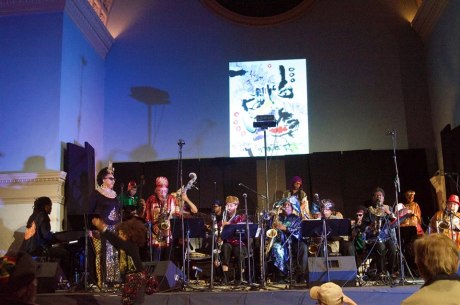
Words by Hank Williams | Photos by Joyce Jones. Creative Commons CC-NC-BY-ND. Main Photo: The Sun Ra Arkestra
On Wednesday night, poet Quincy Troupe took to the stage without introduction and launched into his work, reading from two unpublished collections of his work. Troupe, invited by jazz trumpeter Miles Davis to co-write the musician’s autobiography, has deep connections with jazz, infusing his work with references to musicians and even reading with musical cadences. Troupe knows improvisation, collaboration–and even the need to listen and work as part of an ensemble–as he’s collaborated with musicians before, having worked with trombonist and AACM member George Lewis and including guitarist Kelvyn Bell and saxophonist Hamiet Bluiett on his 2011 SOUNDART release. His set-closing poem “Blue Mandela”, dedicated to Harlem-based artist Xenobia Bailey’s installation in the NYC subway’s new 34th St.-Hudson Yards station, brought Troupe a standing ovation as he exited the stage.
Pianist Connie Crothers’s set was (as promised) an exercise in free improvisation building on her angular, shimmering piano styling nicely complemented by Warren Smith’s solid drumming and Michael Bisio’s standout performance on bass.
The Sun Ra Arkestra returned to Vision as the closing set for the night–fortunately, at an earlier scheduled time than last year, when they took the stage well past midnight.
No strangers to finely honed (and theatrical) performance, the Arkestra entered the hall single file, chanting “this is the planet dream of the Earth Galaxy” as they filed through the standing room only crowd to take the stage. It could also be seen as a continuation of earlier in the day, when the Arkestra was one of the highlights of what’s becoming a Vision tradition of having a parade starting in the adjacent Washington Square Park cross the street to Judson. Marshall Allen, the Arkestra’s 92-year-old leader and conductor, finished off the first song with a positively celestial sounding flourish on the Electronic Valve Instrument (EVI), which Allen uses to supplement his saxophone and has become an acknowledged master at. The sound meshed perfectly with Judson’s acoustics, which are challenging to large ensembles such as the Arkestra. Indeed, the sound was a challenge throughout the set, as musicians signaled for more volume for their instruments. Part of the challenge is the difficult acoustics of Judson itself, a large open church with hard surfaces and high ceilings. Allen seems to have mastered the tricky acoustics, though.
The Arkestra’s “Discipline 27-II” kicked off with the sampled voice of none other than Ra himself sending a missive to the “People of Planet Earth”.
The Arkestra then launched into “Angels and Demons At Play”, with vocalist Middleton’s rich, deep vocals meshing with the synthesizer. Saxophonist Knoel Scott was inspired enough to put down his instrument and step to the front of the stage to show off his dance moves. Multiple roles and talents are simply par for the course for Arkestra members. As vocalist Tara Middleton explained to us after the set, there is no set list with the Arkestra, following how things worked under Ra himself. The band just responds to the vibrations present at the time and chooses songs accordingly.
The next piece matched Middleton’s scatting vocals to Allen’s upper register sax squeals in the bass and electric guitar – heavy tune that had the Arkestra swinging hard.
A bluesy acoustic bass solo kicked off “Blues in the Night”, eventually giving way to flute and electric guitar solo by Dave Hotep that allowed Middleton to show off her Blues chops.
The Arkestra classic “Love in Outer Space” followed and “When You Wish Upon a Star” was given the Arkestra’s unique, slightly atonal treatment and gave Allen the space to kick off the latter with a solo.
The final set-closing medley of “We Travel the Spaceways” and “Space is the Place” with the Arkestra leading a second line through the audience came all too soon.
Despite the issues with sound and acoustics, the Arkestra put in a strong performance, with Allen still playing with a force, intensity, and enthusiasm that defies his age. I’ve written that a few times about the Arkestra before, but it remains true and it’s something I hope to continue reporting for quite a while. However, with the addition of Middleton and other members who’ve been with the Arkestra a long time, Ra’s prodigious back catalog, fresh tunes composed by Allen added to the performance rotation, and the release of the Babylon CD/DVD set, the Arkestra looks set to be continuing traveling the spaceways for quite a while to come.
We’ll be reporting from Vision throughout the festival and I’ll have a wrap-up when it’s all done. If you haven’t caught it already, you can hear our Vision Fest preview show with Marc Ribot, Geri Allen, Lisa Sokolov, and Andrew Cyrille discussing Grimes’s influence and festival organizer Patricia Nicholson Parker talking festival logistics, which she’ll discuss on our colleague Basir Mchawi’s Education at the Crossroads show on Thursday at 7 PM EST. And, remember our next Suga’ in My Bowl show with Andrew Cyrille this Sunday at 11 PM EST on WBAI.
—-
Hank Williams is an associate producer for Suga’ in My Bowl on WBAI Radio and webmaster for the Suga’ and Behind the Mic sites. He is also a PhD candidate in English and Africana Studies at the CUNY Graduate Center and teaches at Hunter and Lehman Colleges and The City College of New York.
Joyce Jones is the executive producer and host of Suga’ in My Bowl. She is a graphic designer and her photos have been published in Black Renaissance Noir.
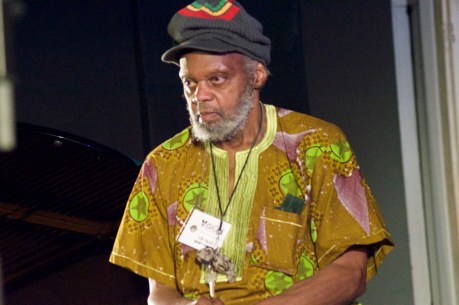
Words by Hank Williams | Photos by Joyce Jones. Creative Commons CC-NC-BY-ND. Main Photo: Vision Fest 21 honoree Henry Grimes
Bassist/violinist/poet Henry Grimes famously doesn’t talk much nowadays: at least not to journalists like myself. To be perfectly clear, it isn’t an issue of him being inaccessible or thinking he’s too good or his time is too valuable: on the contrary, he’s usually in attendance at almost any event having to do with free/avant garde jazz in New York City–usually with his wife and manager Margaret at his side–and is just there digging the music even if he isn’t on the bill or has finished his own set. It’s just that he doesn’t talk a lot, period. An affable smile and recognition is all you’re likely to get. That’s fine since his body of work fills in much of the story. Still, those of us itching to dig deeper and get some of the history he’s been involved in won’t walk away with much more than we see on the bandstand.
Personal testimony isn’t the only story, though, and what your peers say about you counts for a lot. And Grimes’s peers have a lot to say about both the man and his work, which makes focusing the 2016 Vision Fest’s spotlight on Grimes all the more valuable since you’d be hard pressed to find someone with bad things to say about the man as either a person or musician. That’s rare in any industry.
Grimes’s remarkable story of walking away from the jazz spotlight before reemerging 35 years later has been told elsewhere, so I won’t repeat it here. The point is that Grimes is the type of artist who’s easy to overlook if one isn’t deep into jazz — much less the free improvisation that he revels and excels in. All of that makes Vision’s choice to highlight his career this year a good one, especially since he’s been a mainstay at the festival since his return to high level performance was punctuated by a Vision appearance over a decade ago and he’s been a mainstay ever since.
Grimes stood on the bandstand throughout three sets to kick off Vision on Tuesday night as both the honoree and center–figuratively and literally, as he occupied center stage–of all of the performances.
After Vision’s traditional opening invocation, the evening started with an ensemble pairing Grimes with pianist Geri Allen (in her Vision debut), Vision veteran Andrew Cyrille (who’ll be interviewed on Suga’ in My Bowl on Sunday 6/12) on drums, and Graham Haynes on coronet. Grimes alternated between bass and violin, showing equal comfort on each instrument. Allen showed, unsurprisingly, that she can keep up with the best improvisers out there and is as adept at playing more freely as she is in more structured environments. Cyrille, meanwhile, added a solid base for the group’s explorations and punctuated their second song with a steady rhythm on the cowbell.
Grimes has also written a fair amount of poetry, which was the focus of the second set, featuring vocalist Lisa Sokolov’s songs and Grimes’s poetry. Grimes accompanied the Sokolov-led choir of Imani Uzuri, Karma Mayet Johnson, Dwight Trible, and Mixashawn.
The night’s final set featured Mixashawn on saxophone, Melanie Dyer on viola, flutist Nicole Mitchell, and cellist Tomeka Reid joining Grimes’s frequent trio collaborators guitarist Marc Ribot and drummer Chad Taylor. The ensemble produced some of the night’s memorable performances. The first song of the set built to a crescendo riffing off of Mitchell’s repeated flute phrase with Ribot filling in the colors while Grimes kept a steady hand on bass. The set’s third (and last) piece started with a solid beat by Taylor, joined by Mitchell, then Ribot and Grimes. Taylor’s steady rhythms kept driving the group forward as they all set a frenetic pace.
Through it all, Grimes remained impassive, focused intently on the music at hand. While he may be a man of few words, Grimes “speaks” loudly and authoritatively on bass, violin, and written words. All of which were on display tonight.
We’ll be reporting from Vision throughout the festival and I’ll have a wrap-up when it’s all done. If you haven’t caught it already, you can hear our Vision Fest preview show with Marc Ribot, Geri Allen, Lisa Sokolov, and Andrew Cyrille discussing Grimes’s influence and festival organizer Patricia Nicholson Parker talking festival logistics, which she’ll probably discuss on our colleague Basir Mchawi’s Education at the Crossroads show on Thursday at 7 PM EST. And, remember our next Suga’ in My Bowl show with Andrew Cyrille this Sunday at 11 PM EST on WBAI.

-

- Nicole Mitchell
-
- Henry Grimes (left) and Marc Ribot at the 2016 Vision Fest.
-
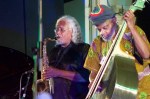
- Mixashawn and Grimes
-

- Chad Taylor
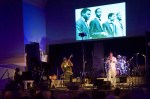
-

- Geri Allen
-
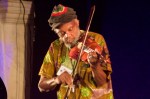
- Henry Grimes
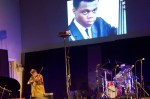
-
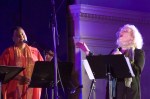
- Lisa Sokolov (Right)
-
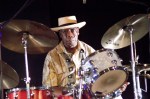
- Andrew Cyrille
-
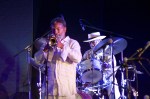
- Graham Haynes (c) and Andrew Cyrille (d)
—-
Hank Williams is an associate producer for Suga’ in My Bowl on WBAI Radio and webmaster for the Suga’ and Behind the Mic sites. He is also a PhD candidate in English and Africana Studies at the CUNY Graduate Center and teaches at Hunter and Lehman Colleges and The City College of New York.
Joyce Jones is the executive producer and host of Suga’ in My Bowl. She is a graphic designer and her photos have been published in Black Renaissance Noir.
 Photo Credit: Hank Williams
Welcome to Suga in My Bowl radio‘s weekly feature, On The Bandstand, where we collect upcoming NYC area shows from current and past Suga’ guests. We’re online weekly and on the air on NYC’s WBAI-FM radio alternate Sunday nights from 11 PM -1 AM. Keep up with us via Facebook, the blog here, or our main website, or Twitter and we’ll keep track of the schedule for you.
We’re off the air this week, but stop by our archives to get your fix from nearly 7 years of archived shows until next week. Look for us at this year’s Vision Festival, which we’ll be reporting from and previewed last week with drummer Andrew Cyrille, guitarist Marc Ribot, vocalist Lisa Sokolof, pianist Geri Allen, and festival organizer Patricia Nicholson Parker.
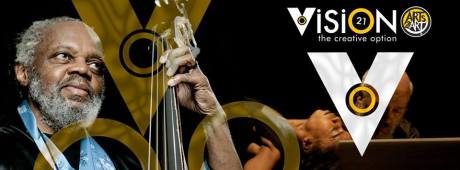
The big event is the Vision Festival and WBAI’s a media sponsor. It starts on the 5th with films celebrating the Sun Ra Arkestra at Anthology Film Archives and moves to Judson Memorial Church from the 7-12 with nightly performances highlighting the career of bassist Henry Grimes. Former guests include poet Quincy Troupe, saxophonist Marshall Allen and the Sun Ra Arkestra, pianist Michele Rosewoman, drummer Hamid Drake, and bassist William Parker. The schedule is at Vision’s site.
AZA, the exhibit of drummer Will Calhoun’s visual art collaboration is on display at the Casita Maria Center for Arts and Education in the South Bronx until July 21st. See our review of the show for more details. Calhoun is also at City Winery for an acoustic show with Living Colour on June 8.
Saxophonist David Murray is at the Harlem Afternoon Jazz Series at Rendall Memorial Presbyterian Church on the 7th.
Vocalist Dee Dee Bridgewater is at the Jazz Standard from the 7-12.
Blues vocalist Alexis P. Suter is at BB King’s on the 8th.
Vocalist Catherine Russell is at Jazz at Lincoln Center’s Appel Room from June 8-9.
Trombonist/seashellist Steve Turre is at Smoke with the “Bones of Art” ensemble from the 8-9.
Saxophonist René McLean is at Smoke, joined by fellow saxophonist Gary Bartz for a Jackie McLean tribute from June 10-12.
Low brass specialist on tuba Joe Daley is at Terra Blues with Hazmat Modine on June 11th.
Vibraphonist Roy Ayers joins Talib Kweli at The Blue Note on June 13th.
Vocalist Rene Marie is at Hunter College’s Kaye Playhouse on the 14th for the National Jazz Museum in Harlem’s annual benefit concert.
Bassist Christian McBride is at The Blue Note from June 14-19th.
Pianist Vijay Iyer is at the Jazz Standard from June 15-19th.
Percussionist Steve Kroon is at Smoke on the 15th.
Pianist /Vocalist Andy Bey is at Mezzrow from the 17-18th.
Poet Sonia Sanchez’s and saxophonist Gary Bartz are at The Blue Note for an afternoon show on June 18th.
Saxophonist Kamasi Washington is at Central Park’s Rumsey Playfield for a free Summerstage performance on the 18th as part of the Blue Note Jazz Festival.
Finally, the Blue Note Jazz festival runs throughout the month and has many more shows in addition to the ones highlighted here.
That’s all for now. Suga’ in My Bowl is back on WBAI‘s airwaves on June 12. We’ll also have another edition of “On the Bandstand” online next Sunday with a fresh set of listings.
—-
Hank Williams is an associate producer for Suga’ in My Bowl on WBAI Radio and webmaster for the Suga’ and Behind the Mic sites. He is also a PhD candidate in English and Africana Studies at the CUNY Graduate Center and teaches at Hunter and Lehman Colleges and The City College of New York.
Photo Credit: Hank Williams
Welcome to Suga in My Bowl radio‘s weekly feature, On The Bandstand, where we collect upcoming NYC area shows from current and past Suga’ guests. We’re online weekly and on the air on NYC’s WBAI-FM radio alternate Sunday nights from 11 PM -1 AM. Keep up with us via Facebook, the blog here, or our main website, or Twitter and we’ll keep track of the schedule for you.
This week’s show is a preview of the 2016 Vision Festival and we’re talking to drummer Andrew Cyrille, guitarist Marc Ribot, vocalist Lisa Sokolof, pianist Geri Allen, and festival organizer Patricia Nicholson Parker.

WBAI’s Spring Fund Drive has begun and We have 2 special premiums. There are signed copies of Quincy Troupe’s book Miles and Me or a one day pass to the Vision Festival. Either is available for a $35 pledge. Both include a year’s station membership and the Vision pass gets you discounted admission. You can pledge online throughout the drive for Miles and Me or for the Vision festival pass — or both. You can also call the hotline at 516-620-3602 if you want to do things the old school way. But act fast: there are limited copies of the book and only 3 Vision passes available. When they’re gone, they’re gone.
The big event is the Vision Festival and WBAI’s a media sponsor. It starts on the 5th with films celebrating the Sun Ra Arkestra at Anthology Film Archives and moves to Judson Memorial Church from the 7-12 with nightly performances highlighting the career of bassist Henry Grimes. Former guests include poet Quincy Troupe, saxophonist Marshall Allen and the Sun Ra Arkestra, pianist Michele Rosewoman, drummer Hamid Drake, and bassist William Parker. The schedule is at Vision’s site and my long-promised preview really is on the way this week.
AZA, the exhibit of drummer Will Calhoun’s visual art collaboration is on display at the Casita Maria Center for Arts and Education in the South Bronx until July 21st. See our review of the show for more details. Calhoun will be at the Blue Note on May 30th with McCoy Tyner. He’s also at The Blue Note with Living Colour in a special free show on the 31st and acoustic Living Colour shows at City Winery on June 1 and 8.
Saxophonist Lakecia Benjamin leads the Soulsquad at Jazz at Lincoln Center’s Dizzy’s Club on May 31.
Poet/playwright Sonia Sanchez’s plays Sister Son/Ji and The Bronx is Next have a short run at Restoration Plaza’s Skylight Gallery in Brooklyn from June 2-4.
Low brass specialist on tuba Joe Daley is at Le Poisson Rouge with Hazmat Modine on June 4 and Terra Blues on the 11th.
Trombonist/seashellist Steve Turre is at Borough of Manhattan Community College’s Tribeca Performing Arts Center on the 4th for the Lost Jazz Shrines series and at Smoke with the “Bones of Art” ensemble from the 8-9.
Drummer Roy Haynes is at Central Park’s Rumsey Playfield for a free Summerstage performance with pianist McCoy Tyner on the 4th.
Looking ahead, Saxophonist David Murray is at the Harlem Afternoon Jazz Series at Rendall Memorial Presbyterian Church on the 7th.
Vocalist Dee Dee Bridgewater is at the Jazz Standard from the 7-12.
Blues vocalist Alexis P. Suter is at BB King’s on the 8th.
Vocalist Catherine Russell is at Jazz at Lincoln Center’s Appel Room from June 8-9.
Saxophonist René McLean is at Smoke, joined by fellow saxophonist Gary Bartz for a Jackie McLean tribute from June 10-12.
Finally, the Blue Note Jazz festival runs throughout the month and we’ll highlight some of the shows next time.
That’s all for now. Suga’ in My Bowl is back on WBAI‘s airwaves on June 12. We’ll also have another edition of “On the Bandstand” online next Sunday with a fresh set of listings.
—-
Hank Williams is an associate producer for Suga’ in My Bowl on WBAI Radio and webmaster for the Suga’ and Behind the Mic sites. He is also a PhD candidate in English and Africana Studies at the CUNY Graduate Center and teaches at Hunter and Lehman Colleges and The City College of New York.
Photo Credit: Hank Williams
Welcome to Suga in My Bowl radio‘s weekly feature, On The Bandstand, where we collect upcoming NYC area shows from current and past Suga’ guests. We’re online weekly and on the air on NYC’s WBAI-FM radio alternate Sunday nights from 11 PM -1 AM. Keep up with us via Facebook, the blog here, or our main website, or Twitter and we’ll keep track of the schedule for you.
We’re off the air this week, but stop by our archives to get your fix from nearly 7 years of archived shows until next week. The promised preview of the NYC summer jazz concert season is coming later this week as well — for real this time. As usual, we have lots more music for you this week.
WBAI’s Spring Fund Drive has begin and we’ve put together a special premium for you. We have 10 autographed copies of Quincy Troupe’s book Miles and Me available for a pledge of $35 to WBAI. The book is his remembrances of knowing and working with Davis on his autobiography and commentary on the music and life from one of the very few people who was close to the man.You can pledge throughout the drive at WBAI’s pledge site.
AZA, the exhibit of drummer Will Calhoun’s visual art collaboration is on display at the Casita Maria Center for Arts and Education in the South Bronx until July 21st. See our review of the show for more details. Calhoun will be at the Blue Note on May 30th with McCoy Tyner.
Drummer and percussionist Bobby Sanabria leads Quarteto Ache at the New Jersey Performing Arts Center in Newark on the 27th with Latino poets.
Percussionist Adam Rudolph has a residency at The Stone from May 24-29 and is joined by Graham Haynes on the 25th, 27th, and 28th.
Pianist Harold Mabern is at Mezzrow with saxophonist Eric Alexander from May 25-26.
Trumpeter Marcus Printup is Jazz at Lincoln Center’s Dizzy’s Club with the JALC Orchestra from May 25-26.
Poet and author Quincy Troupe and Margaret Porter Troupe at the Harlem Arts Salon on May 26th for a Miles Davis birthday event. They’re joined by saxophonist Gary Bartz and percussionist James Mtume Reservations are required and can be done at their site.
Saxophonist René McLean is at Sista’s Place in Brooklyn on the 28th for an African Liberation Day celebration.
Saxophonist Lakecia Benjamin leads the Soulsquad at Jazz at Lincoln Center’s Dizzy’s Club on May 31.
Low brass specialist on tuba Joe Daley is at Le Poisson Rouge with Hazmat Modine on June 4.
That’s all for now. Suga’ in My Bowl is back on WBAI‘s airwaves on May 29. We’ll also have another edition of “On the Bandstand” online next Sunday with a fresh set of listings.
—-
Hank Williams is an associate producer for Suga’ in My Bowl on WBAI Radio and webmaster for the Suga’ and Behind the Mic sites. He is also a PhD candidate in English and Africana Studies at the CUNY Graduate Center and teaches at Hunter and Lehman Colleges and The City College of New York.
Photo Credit: Hank Williams
Welcome to Suga in My Bowl radio‘s weekly feature, On The Bandstand, where we collect upcoming NYC area shows from current and past Suga’ guests. We’re online weekly and on the air on NYC’s WBAI-FM radio alternate Sunday nights from 11 PM -1 AM. Keep up with us via Facebook, the blog here, or our main website, or Twitter and we’ll keep track of the schedule for you.
This week’s guests are poet and author Quincy Troupe and Margaret Porter Troupe. You can see both of them along with saxophonist Gary Bartz and percussionist James Mtume at the Harlem Arts Salon on May 26th for a Miles Davis birthday event. Reservations are necessary and can be done at their site.
WBAI’s Spring Fund Drive has begin and we’ve put together a special premium for you. We have 10 autographed copies of Quincy Troupe’s book Miles and Me available for a pledge of $35 to WBAI. The book is his remembrances of knowing and working with Davis on his autobiography and commentary on the music and life from one of the very few people who was close to the man.You can pledge throughout the drive at WBAI’s pledge site.
AZA, the exhibit of drummer Will Calhoun’s visual art collaboration is on display at the Casita Maria Center for Arts and Education in the South Bronx until July 21st. See our review of the show for more details. Calhoun will be at the Blue Note on May 30th with McCoy Tyner.
Drummer JT Lewis is with cellist Marika Hughes on the 16th at the Blue Note.
Bassist Bob Cranshaw is at Cassanrda’s Jazz Club in Harlem on the 16th.
Looking further ahead, Tubist Howard Johnson is at Craig Harris’s Harlem Afternoon Jazz Series at Rendall Memorial Presbyterian Church for two lunchtime sets on May 17th.
The MAC Power Trio of saxophonist David Murray, pianist Geri Allen, drummer Teri Lyne Carrington, and celebrates the release of their CD debut Perfection at Birdland from May 17-21.
Pianist Harold Mabern leads a trio at Small’s on the 18th.
Vocalist Thana Alexa is at 55 Bar on the 18th and the 20th.
Harpist Brandee Younger is at Tavern on the Lake in East Windsor NJ on the 20th.
Pianist and vocalist Diane Schuur is at Jazz at Lincoln Center’s Rose Theater from May 20-21st.
Low brass specialist on tuba Joe Daley is at Terra Blues with Hazmat Modine on the 21st.
Drummer and percussionist Bobby Sanabria is at Borough of Manhattan Community College’s Tribeca Performing Arts Center at the on the 21st for the Made in New York Gala, and leads Quarteto Ache at the New Jersey Performing Arts Center in Newark on the 27th with Latino poets.
Percussionist Adam Rudolph has a residency at The Stone from May 24-29 and is joined by Graham Haynes on the 25th, 27th, and 28th.
Trumpeter Marcus Printup is Jazz at Lincoln Center’s Dizzy’s Club with the JALC Orchestra from May 25-26.
Saxophonist Lakecia Benjamin leads the Soulsquad at Jazz at Lincoln Center’s Dizzy’s Club on May 31.
That’s all for now. Suga’ in My Bowl is back on WBAI‘s airwaves on May 29. We’ll also have another edition of “On the Bandstand” online next Sunday with a fresh set of listings.
—-
Hank Williams is an associate producer for Suga’ in My Bowl on WBAI Radio and webmaster for the Suga’ and Behind the Mic sites. He is also a PhD candidate in English and Africana Studies at the CUNY Graduate Center and teaches at Hunter and Lehman Colleges and The City College of New York.
Photo Credit: Hank Williams
Welcome to Suga in My Bowl radio‘s weekly feature, On The Bandstand, where we collect upcoming NYC area shows from current and past Suga’ guests. We’re online weekly and on the air on NYC’s WBAI-FM radio alternate Sunday nights from 11 PM -1 AM. Keep up with us via Facebook, the blog here, or our main website, or Twitter and we’ll keep track of the schedule for you.
We’re off the air this week, but stop by our archives to get your fix from nearly 7 years of archived shows until next week. Check back later in the week for a preview of the NYC summer jazz concert season in a separate post. As usual, we have lots more music for you this week.
We start this week with the Central Brooklyn Jazz Consortium, whose 17th annual jazz festival runs in in venues throughout Brooklyn and wraps up on May 15th. WBAI Radio is a media sponsor. See the CJBC’s website for the schedule (opens as a PDF).
AZA, the exhibit of drummer Will Calhoun’s visual art collaboration is on display at the Casita Maria Center for Arts and Education in the South Bronx until July 21st. See our review of the show for more details. Calhoun will be at the Blue Note on May 30th with McCoy Tyner.
Guitarist Julian Lage is at Drom on the Lower East Side on May 11th and the Jazz Standard on May 12th.
Pianist Michele Rosewoman leads her Quintessence ensemble at Zinc Bar on May 12.
Pianist/keyboardist Marc Cary is at Ginny’s Supper Club on the 14th.
Drummer and percussionist Bobby Sanabria is at Carnegie Hall on the 14th for a free, afternoon “Carnegie Kids” show (reservations are necessary), at Borough of Manhattan Community College’s Tribeca Performing Arts Center at the on the 21st for the Made in New York Gala, and leads Quarteto Ache at the New Jersey Performing Arts Center in Newark on the 27th with Latino poets.
Saxophonist Oliver Lake is at the 17 White St Loft in Manhattan for a duo performance with bassist Joe Fonda on May 15th.
Looking further ahead, Tubist Howard Johnson is at Craig Harris’s Harlem Afternoon Jazz Series at Rendall Memorial Presbyterian Church for two lunchtime sets on May 17th.
The MAC Power Trio of saxophonist David Murray, pianist Geri Allen, drummer Teri Lyne Carrington, and celebrates the release of their CD debut Perfection at Birdland from May 17-21.
Pianist Harold Mabern leads a trio at Small’s on the 18th.
Vocalist Thana Alexa is at 55 Bar on the 18th and the 20th.
Harpist Brandee Younger is at Tavern on the Lake in East Windsor NJ on the 20th.
Pianist and vocalist Diane Schuur is at Jazz at Lincoln Center’s Rose Theater from May 20-21st.
That’s all for now. Suga’ in My Bowl is back on WBAI‘s airwaves on May 15. We’ll also have another edition of “On the Bandstand” online next Sunday with a fresh set of listings.
—-
Hank Williams is an associate producer for Suga’ in My Bowl on WBAI Radio and webmaster for the Suga’ and Behind the Mic sites. He is also a PhD candidate in English and Africana Studies at the CUNY Graduate Center and teaches at Hunter and Lehman Colleges and The City College of New York.
Photo Credit: Hank Williams
Welcome to Suga in My Bowl radio‘s weekly feature, On The Bandstand, where we collect upcoming NYC area shows from current and past Suga’ guests. We’re online weekly and on the air on NYC’s WBAI-FM radio alternate Sunday nights from 11 PM -1 AM. Keep up with us via Facebook, the blog here, or our main website, or Twitter and we’ll keep track of the schedule for you.
This week’s guests are harpist Riza Printup and trumpeter Marcus Printup. Marcus leads a sextet at Jazz at Lincoln Center’s Dizzy’s Club on May 25th and 26th. As usual, we have lots more music for you this week.
We start this week with the Central Brooklyn Jazz Consortium, whose 17th annual jazz festival kicked off on the 15th and runs until May 15th in venues throughout Brooklyn. WBAI Radio is a media sponsor. See the CJBC’s website for the schedule (opens as a PDF).
AZA, the exhibit of drummer Will Calhoun’s visual art collaboration is on display at the Casita Maria Center for Arts and Education in the South Bronx until July 21st. See our review of the show for more details. Calhoun will be at the Blue Note on May 30th with McCoy Tyner.
Pianist Michele Rosewoman leads her Quintessence ensemble at Zinc Bar on May 5.
Organist John Medeski is at The Stone on May 6.
Low brass specialist on tuba Joe Daley is at Terra Blues with Hazmat Modine on May 7th.
Vocalist Kurt Elling, bassist Christian McBride, and vocalist Dianne Reeves all lead groups at the Prospect Park Bandshell on May 7-8th as part of the GRAMMY Park festival.
Finally, The Red Bull Music Academy has a night of spiritual Jazz featuring Pharoah Sanders, the Sun Ra Arkestra, and Kamasi Washington on May 8. The event’s listed as sold out, but details are at the Red Bull Music Academy site and there may be a wait list.
Guitarist Julian Lage is at Drom on the Lower East Side on May 11th and the Jazz Standard on May 12th.
Pianist/keyboardist Marc Cary is at Ginny’s Supper Club on the 14th.
Drummer and percussionist Bobby Sanabria leads Quarteto Ache at Carnegie Hall on the 14th and will be at the Tribeca Performing Arts Center at the Borough of Manhattan Community College on the 21st for the Made in New York Gala.
Saxophonist Oliver Lake is at the 17 White St Loft in Manhattan for a duo performance with bassist Joe Fonda on May 15th.
Looking further ahead, Tubist Howard Johnson is at Craig Harris’s Harlem Afternoon Jazz Series at Rendall Memorial Presbyterian Church for two lunchtime sets on May 17th.
The MAC Power Trio of saxophonist David Murray, pianist Geri Allen, drummer Teri Lyne Carrington, and celebrates the release of their CD debut Perfection at Birdland from May 17-21.
That’s all for now. Suga’ in My Bowl is back on WBAI‘s airwaves on May 15. We’ll also have another edition of “On the Bandstand” online next Sunday with a fresh set of listings.
—-
Hank Williams is an associate producer for Suga’ in My Bowl on WBAI Radio and webmaster for the Suga’ and Behind the Mic sites. He is also a PhD candidate in English and Africana Studies at the CUNY Graduate Center and teaches at Hunter and Lehman Colleges and The City College of New York.

Words by Hank Williams | Photos by Joyce Jones. Creative Commons CC-NC-BY-ND. Main Photo: Will Calhoun working the drum kit.
It would be inaccurate to call the opening of Will Calhoun’s first collaborative visual art show at the Casita Maria Center for Arts and Education gallery a homecoming because the Bronx native never really left. Nevertheless, the reception and performance had that sort of feel, as it drew family members, friends, and even former schoolmates to the South Bronx location on Friday April 22nd.
Calhoun, known to many as the drummer for the resurgent rock band Living Colour, has fashioned a solid career for himself as a jazz bandleader (with an eagerly anticipated album of Elvin Jones songs on Motéma Records due this summer) and side projects ranging from Jungle Funk with vocalist Vinx and Living Colour bandmate Doug Wimbish to his collaboration with fellow Living Colour bandmate Vernon Reid as part of the latter’s Power Trio.
Calhoun has long had an interest in visual art, however, and said that he began exploring photography about ten years ago. Indeed, his Native Lands CD came packaged with a DVD documenting a decade of his travels.
All of the above has happened while the busy family man (his teenage son is a regular presence at New York area shows) has spent a fair amount of his time in between projects doing research on the African continent and its musical musical traditions — many of which are incorporated into his work in one way or another.
Given that history, the trip to a seemingly unlikely spot on the sixth floor gallery perched atop a Bronx school makes sense. Christine Licata, Casita Maria’s Performing and Visual Arts Director, said that they came to know Calhoun through his music over a series of Latin Jazz concerts presented in the area by the Blitz collective, featuring Calhoun and acclaimed pianist Arturo O’Farrill. Showing Calhoun’s visual art was a perfect fit for the gallery, given his Bronx roots, musical connections, the organization’s goals, and the connection with the attached school. Licata referred to art as a “tool to open up the way youth see the world.”
The process of creating the pieces in the current show came from a collaboration with the Los Angeles-based SceneFour visual art team, which has done similar collaborations with several other musicians. After recording videos of him drumming with lighted sticks, the resulting canvases were created from his actual movements. “What you see” on the canvases, said Calhoun, “is a map of me playing.” He also suggested that the project adds a different way of seeing himself as an artist. He’s used to capturing the audio of his work, but seeing and interpreting the movements offers a fresh look at his artistry and way to appreciate the physicality of drumming.
The result is 11 limited edition pieces that convert the sense of rhythm, motion, color, and excitement that Calhoun’s music creates. Ethel, for instance, is generated from Calhoun’s movements playing the wave drum and is inspired buy his sister, who dances ballet and African dance. The piece emphasizes vertical, rather than horizontal movements, and the swirling lines tracing his hand movements suggest the movements of a dancer. Calhoun revealed that it’s one of the more popular pieces.
My Own Free Will, on the other hand, has Calhoun seated at the drum kit, working his magic and was meant to convey the total improvisation both rhythmically and visually. Calhoun’s face and silhouette are visible in the center of the canvas, his calm visage in contrast to the swirling blue lines from his drumsticks. The title is a play on both his first name and the idea of an artist’s freedom of expression and the risks involved in creativity and pushing the boundaries of your work. To be successful as an artist, “you can’t be afraid to fail”, said Calhoun, and “you can’t be afraid to make mistakes”. The canvas effectively conveys the tension between the competing demands of an artist: the quest for hitting the right note or getting the pleasing balance of visuals and pushing the boundaries of how far out one can go before failing.

My Own Free Will. Will Calhoun/SceneFour. Hank Williams Photo
In Sundance, vibrant swirl of yellow on the white background is punctuated by bold splashes of contrasting orange and black highlights in the center of the piece. It conveys the feeling suggested in the title of brightness, light, and sunshine with a playful quality.

Sundance. Will Calhoun/SceneFour. Joyce Jones Photo
Calhoun demonstrated part of his end of the composition process in a solo performance of three pieces that evening. He introduced one song with the promise of playing “a little bit of Bronx music for y’all”, a pledge faithfully delivered with a rendition of hip hop-inspired break beats. Another piece, clearly inspired by his North and West African travels began with seamless alternation between drumsticks and brushes. A stint on the wave drum and synthesizer transformed Calhoun into a multidisciplinary DJ, the resulting beats recorded as the base for his accompaniment on the drum kit. A final piece had Calhoun switch to the special drumsticks with embedded LED lights, resulting in a Technicolor and sonic whirlwind.
When asked how it felt to have his first show open in the Bronx, Calhoun replied that “it feels amazing because that’s where I’m from”. “What you’re seeing is my life’s work”.


For a deeper dive into Calhoun, see Joyce Jones’s 2013 interview with him on the Suga’ in My Bowl show.
AZA is on display until July 21, 2016 at the Casita Maria Center for Arts and Education. Will Calhoun’s next effort as a leader is a a tribute to drummer Elvin Jones, scheduled for a summer 2016 release. Calhoun will be appearing at New York’s Blue Note jazz club as a guest with pianist McCoy Tyner on Tuesday April 26. He’ll also be at City Winery on June 1st and 8th for acoustic sets with Living Colour as part of their world tour for their new release, SHADE, tentatively scheduled for fall 2016.
—-
Hank Williams is an associate producer for Suga’ in My Bowl on WBAI Radio and webmaster for the Suga’ and Behind the Mic sites. He is also a PhD candidate in English and Africana Studies at the CUNY Graduate Center and teaches at Hunter and Lehman Colleges and The City College of New York.
Joyce Jones is the executive producer and host of Suga’ in My Bowl. She is a graphic designer and her photos have been published in Black Renaissance Noir.
Photo Credit: Hank Williams
Welcome to Suga in My Bowl radio‘s weekly feature, On The Bandstand, where we collect upcoming NYC area shows from current and past Suga’ guests. We’re online weekly and on the air on NYC’s WBAI-FM radio alternate Sunday nights from 11 PM -1 AM. Keep up with us via Facebook, the blog here, or our main website, or Twitter and we’ll keep track of the schedule for you.
We’re off the air this week, but stop by our archives to get your fix from nearly 7 years of archived shows until next week. Also see our review of Will Calhoun’s art exhibit on display in the South Bronx. As usual, we have lots more music for you this week.
We start this week with the Central Brooklyn Jazz Consortium, whose 17th annual jazz festival kicked off on the 15th and runs until May 15th in venues throughout Brooklyn. WBAI Radio is a media sponsor. You can get full information and a schedule from the CBJC by calling 718-773-2252 ext 103.
Saxophonist Tia Fuller is at The Blue Note on the 25th with the Berklee Rainbow All Stars.
AZA, the exhibit of drummer Will Calhoun’s visual art collaboration is on display at the Casita Maria Center for Arts and Education in the South Bronx until July 21st. Calhoun will be at the Blue Note on the 26th May 30th with McCoy Tyner.
Pianist Randy Weston has a busy week. He leads the African Rhythms ensemble with bassist Alex Blake in the Dweck Center of the Brooklyn Public Library’s main branch on the 26th and in a free performance at New School University’s Tishman Auditorium on the 28th to close out his yearlong residency. Finally, Weston returns to the Dweck Center on the 30th for a talk on the African roots of jazz. The Brooklyn library events are part of the Central Brooklyn Jazz Festival.
Looking further ahead, Saxophonist Oliver Lake and bassist Reggie Workman are at Village Vanguard with TRIO3 from April 26-May 1.
Pianist Barry Harris leads a trio in a lunchtime set at St. Peter’s Church on April 27th.
Drummer Billy Cobham is at The Blue Note from April 27-May 1 with Donald Harrison.
Drummer Kim Thompson leads a quartet at Zinc Bar on the 29th.
Saxophonist Ahmed Abdullah leads his DIASPORA band at Sistas’ Place on April 30. This event is part of the Central Brooklyn Jazz Festival.
Pianist Geri Allen is at Jazz at Lincoln Center’s Dizzy’s Club on April 30 with Joe Lovano.
Saxophonist and EVI master Marshall Allen makes a rare non-Arkestra Earthly appearance with two sets at The Stone on April 30.
Low brass specialist on tuba Joe Daley is at The Stone on May 1 for the early set and at Terra Blues with Hazmat Modine on May 7th.
Vocalist Kurt Elling, bassist Christian McBride, and vocalist Dianne Reeves all lead groups at the Prospect Park Bandshell on May 7 as part of the GRAMMY Park festival.
Pianist Michele Rosewoman leads her Quintessence ensemble at Zinc Bar on May 5.
Organist John Medeski is at The Stone on May 6.
Finally, The Red Bull Music Academy has a night of spiritual Jazz featuring Pharoah Sanders, the Sun Ra Arkestra, and Kamasi Washington on May 8. The event’s listed as sold out, but details are at the Red Bull Music Academy site and there may be a wait list.
That’s all for now. Suga’ in My Bowl is back on WBAI‘s airwaves on May 1. We’ll also have another edition of “On the Bandstand” online next Sunday with a fresh set of listings.
—-
Hank Williams is an associate producer for Suga’ in My Bowl on WBAI Radio and webmaster for the Suga’ and Behind the Mic sites. He is also a PhD candidate in English and Africana Studies at the CUNY Graduate Center and teaches at Hunter and Lehman Colleges and The City College of New York.

 Behind the Mic